
Electricity 101
Recently, I took a training course to learn about electricity. On paper, at the end of the training, the student is expected to be able to set up a single-phase home electrical installation, and to bring an existing electrical installation up to standard.
Now that the training is over, I can confirm this is indeed the case!
A bit of context
My knowledge of electricity was very basic. I didn’t have any theoretical fundamentals (what I learnt in school is too far behind me to remember anything from it), and in practice, my experience was limited to replacing lamps and extending the electrical lines dedicated to those lamps. Before this training, I had never installed a light switch, a plug socket, run an electrical line, etc. and I had barely touched my electric panel (only to cut off the power).
Electricity was something I didn’t know anything about. It impressed me, and it even scared me, because I simply didn’t know how it actually works.
However, it’s a topic that has always been interesting to me and I wanted to understand it better. Especially over the past few years, because I moved into a pretty old house which required quite a lot of work, particularly electrical work.
These days, I’ve been more and more interested in:
- Learning and understanding how electricity works
- Working safely
- Being able to identify a breakdown
- Being able to change and upgrade my current electrical setup without always relying on a professional
Another reason I wanted to learn electricity is the complete electrical renovation of an outbuilding on my land: replacing an old electrical panel and setting up a network of lights and plug sockets.
The training
A few months ago, I found this one-week training combining theory and, most importantly, practice, a lot of practice. During the week, there is a first exam to obtain an official electric clearance, allowing me to safely work on a low-voltage live electrical installation. The week ends with another exam (a multiple-choice questionnaire, a practical exercise and an interview) which awards a state-recognised certificate of professional skills. This certificate alone, fortunately, does not allow one to be self-employed.
One week might sound quite short, especially starting from nothing or almost. But in fact, the schedule is well built, step-by-step, and intensive. It combines on-site training (during the day, for the theoretical and especially the practical parts) and e-learning (in the evening, specifically to learn and get ready for the theoretical part of the following morning). The whole training is based on the NF C 15-100 standard, a set of mandatory technical rules governing the design, installation, and maintenance of low-voltage electrical systems, defined by a national standardization body, to ensure their safety. If interested, more information on this website (in English) or on Wikipedia (in French).
Each day, the first half of the morning is dedicated to the theoretical part (electrical concepts and laws, installation rules, safety, reading and drawing electrical diagrams, etc.), and the rest of the day is dedicated to practical exercises, basic at first, and increasingly complex.
To work in good conditions, like every student, I had at my disposal: a complete toolbox, all the necessary equipment and materials, and a workspace to apply the concepts studied with the trainer through hands-on exercises.
A few snapshots
Here are a few pictures I took during that week (displayed chronologically).
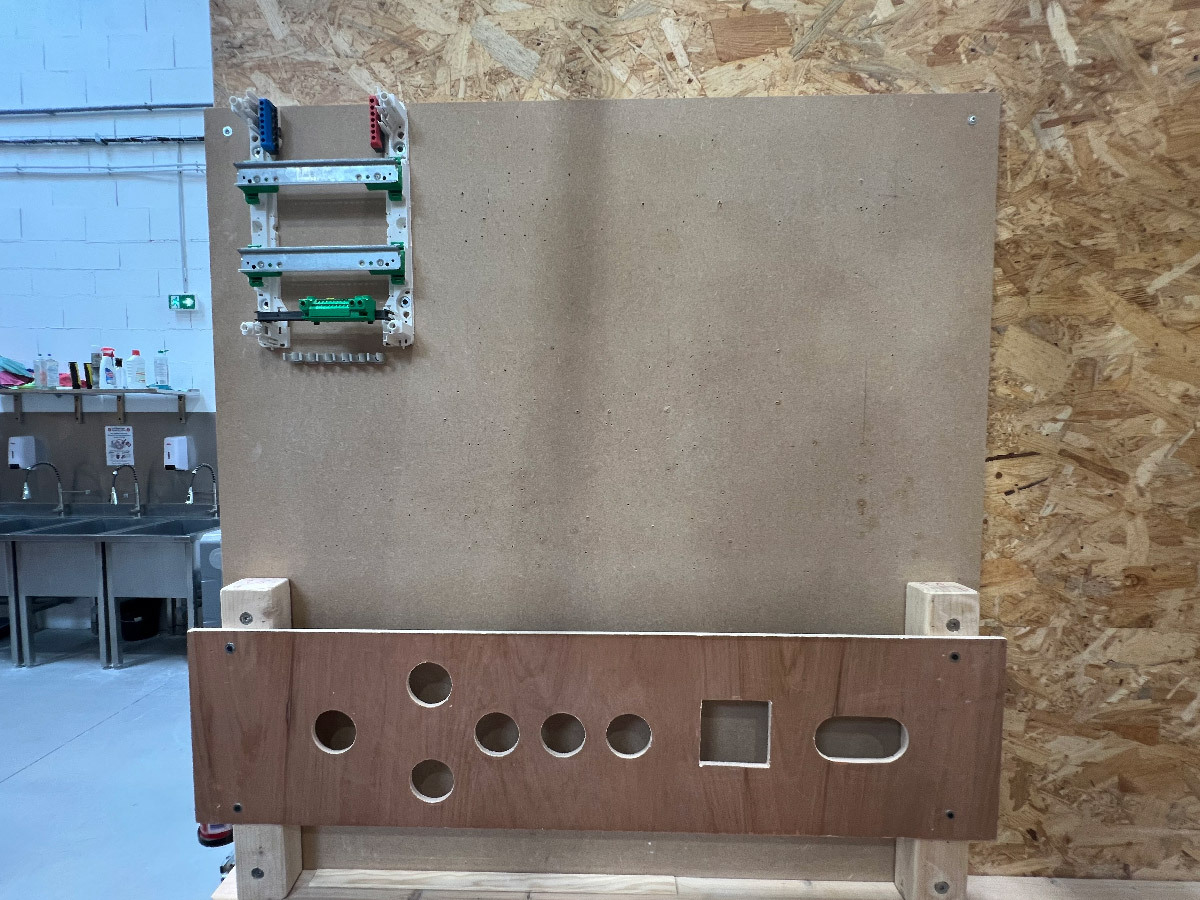
↑ Setting up my work spot: fixing wooden templates and an empty electrical board.
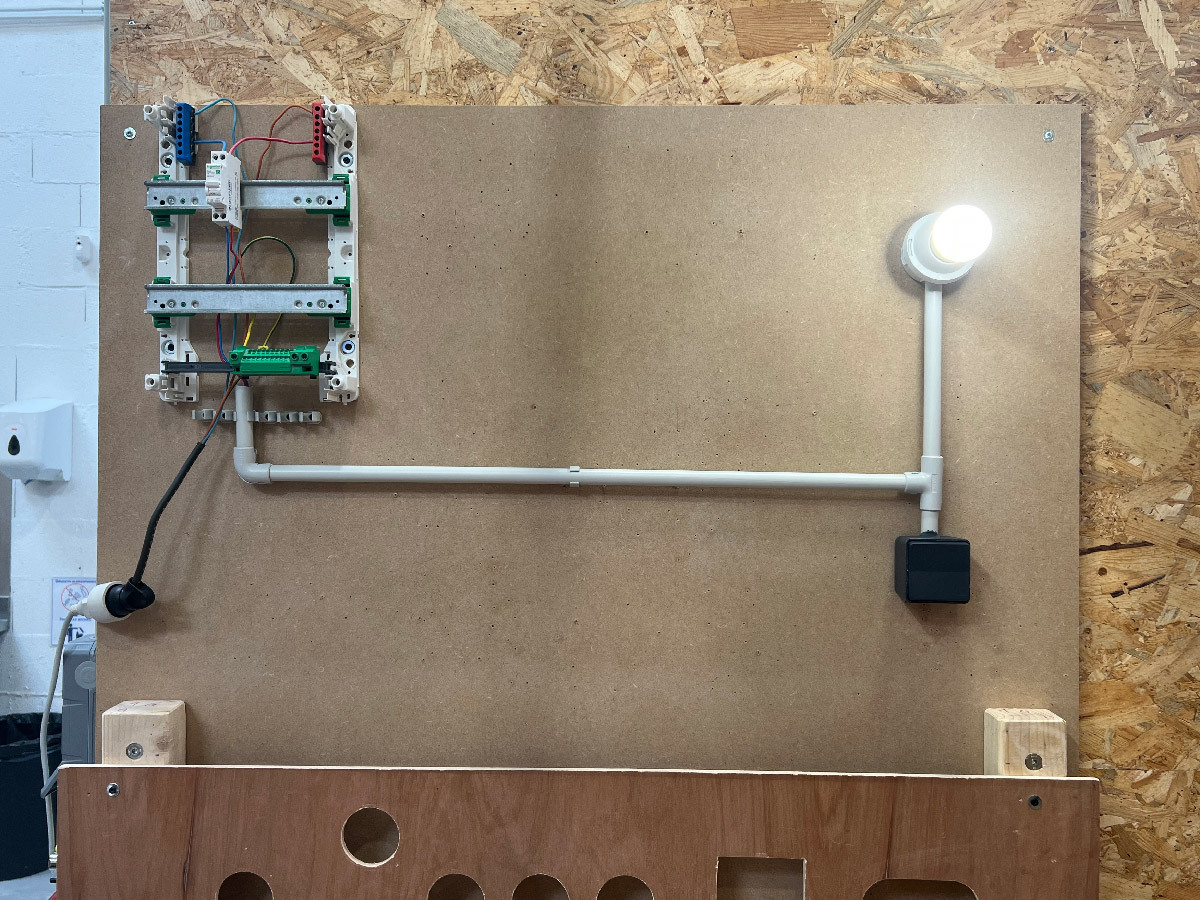
↑ Installation of a one-way light switch.
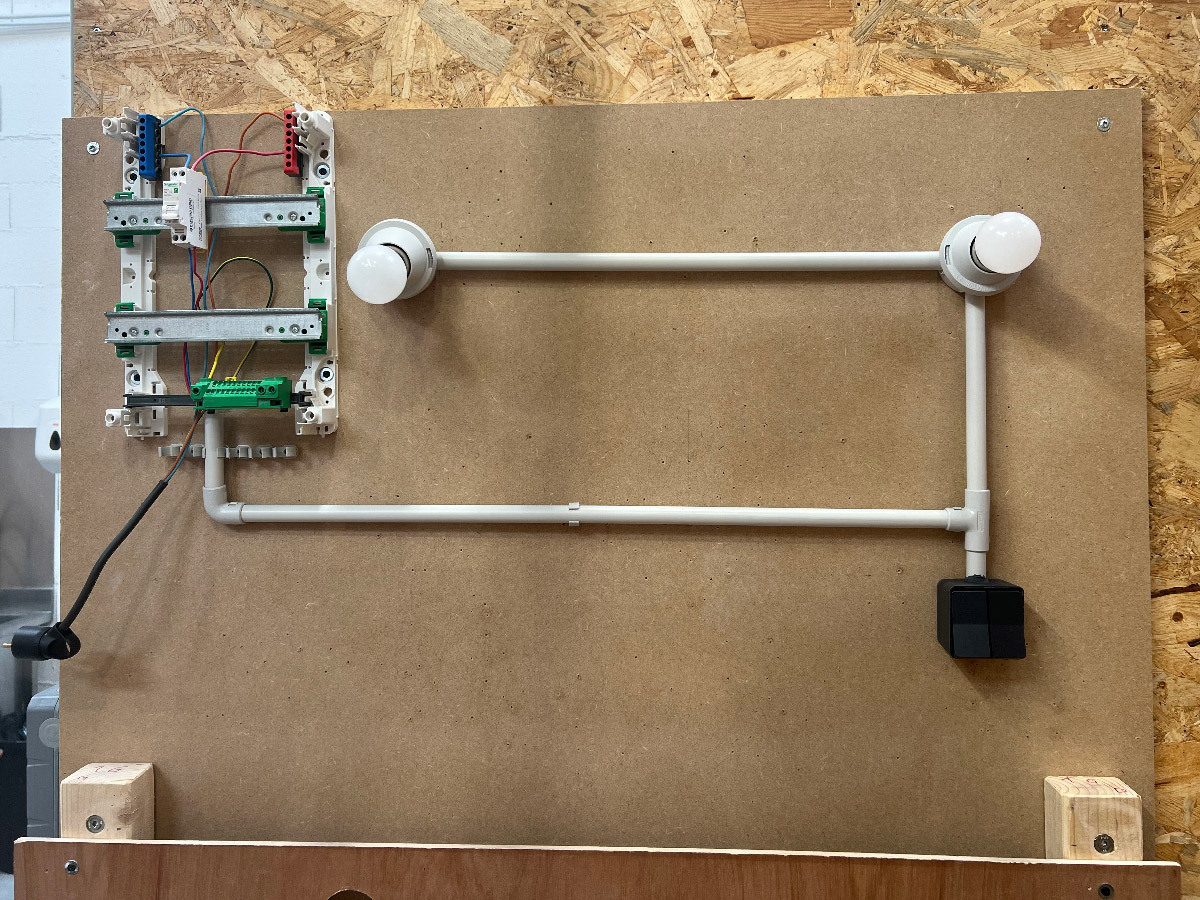
↑ Installation of a two-way light switch.
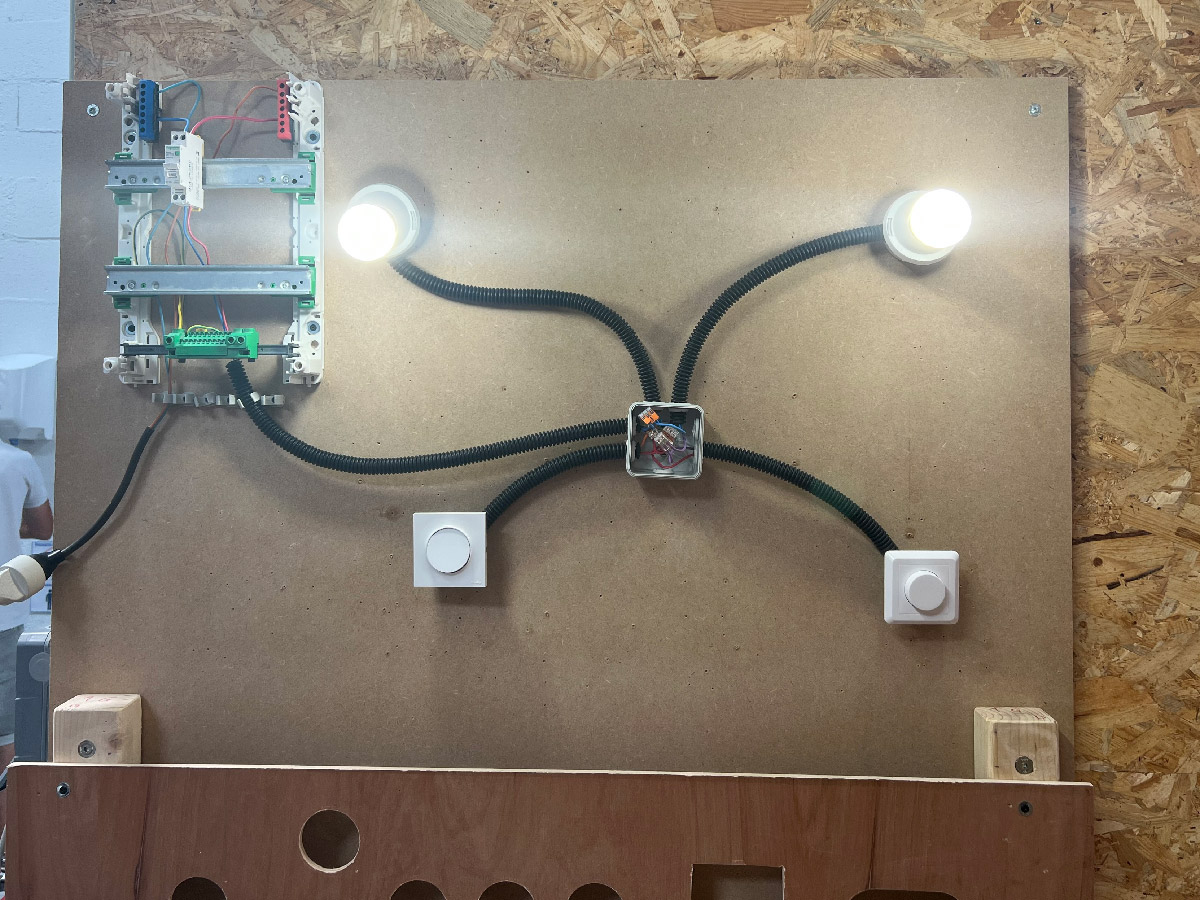
↑ Installation of a junction box for a light point controlled by a one-way switch, and another one by a dimmer switch.
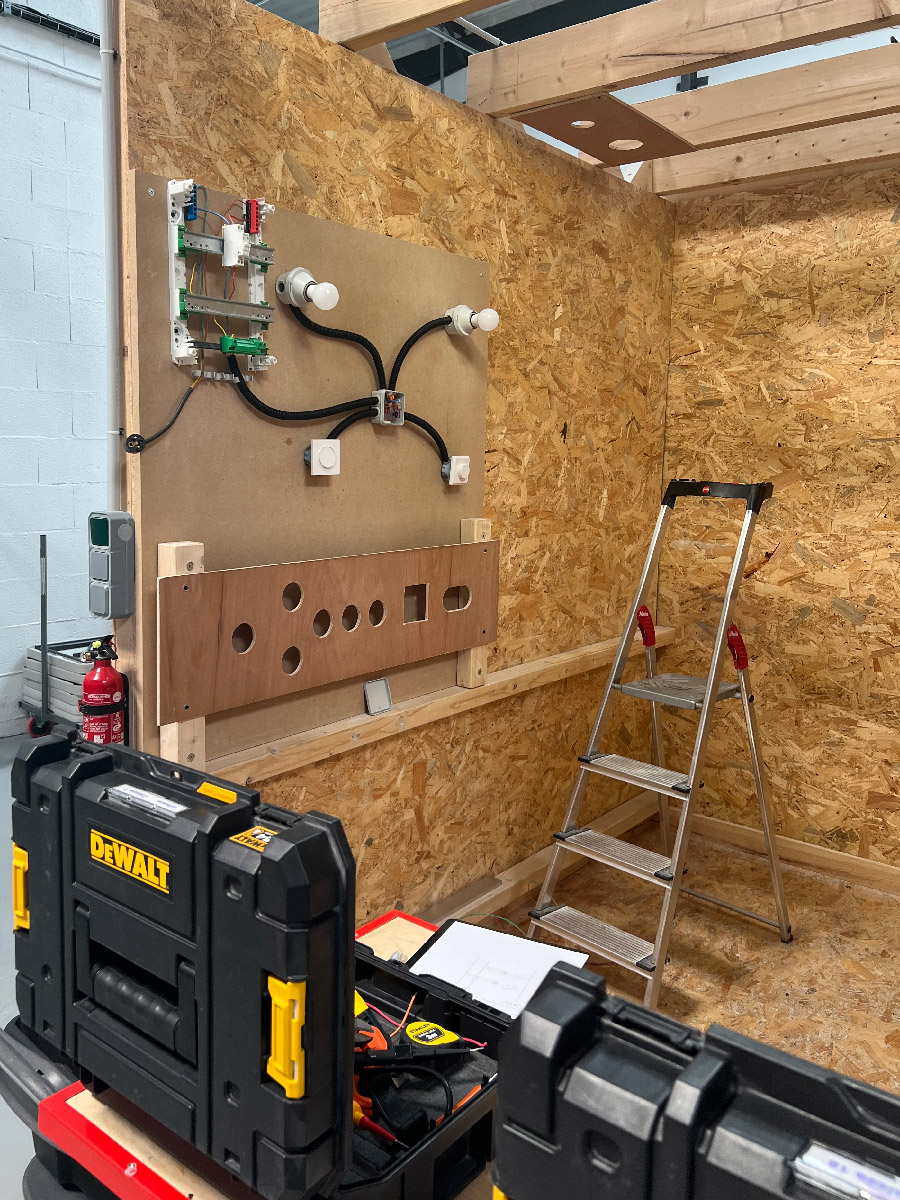
↑ My working area.
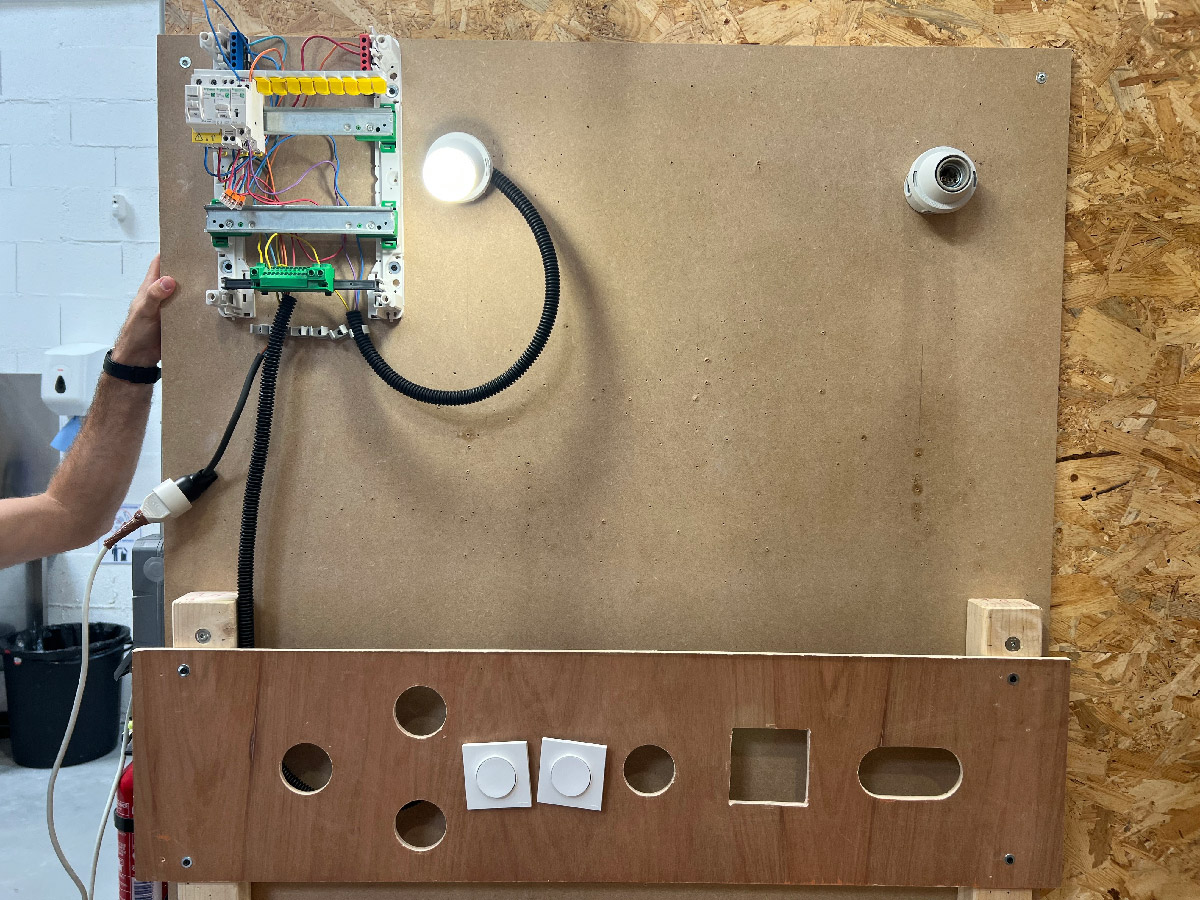
↑ Installation of a latching switch with two push-buttons.
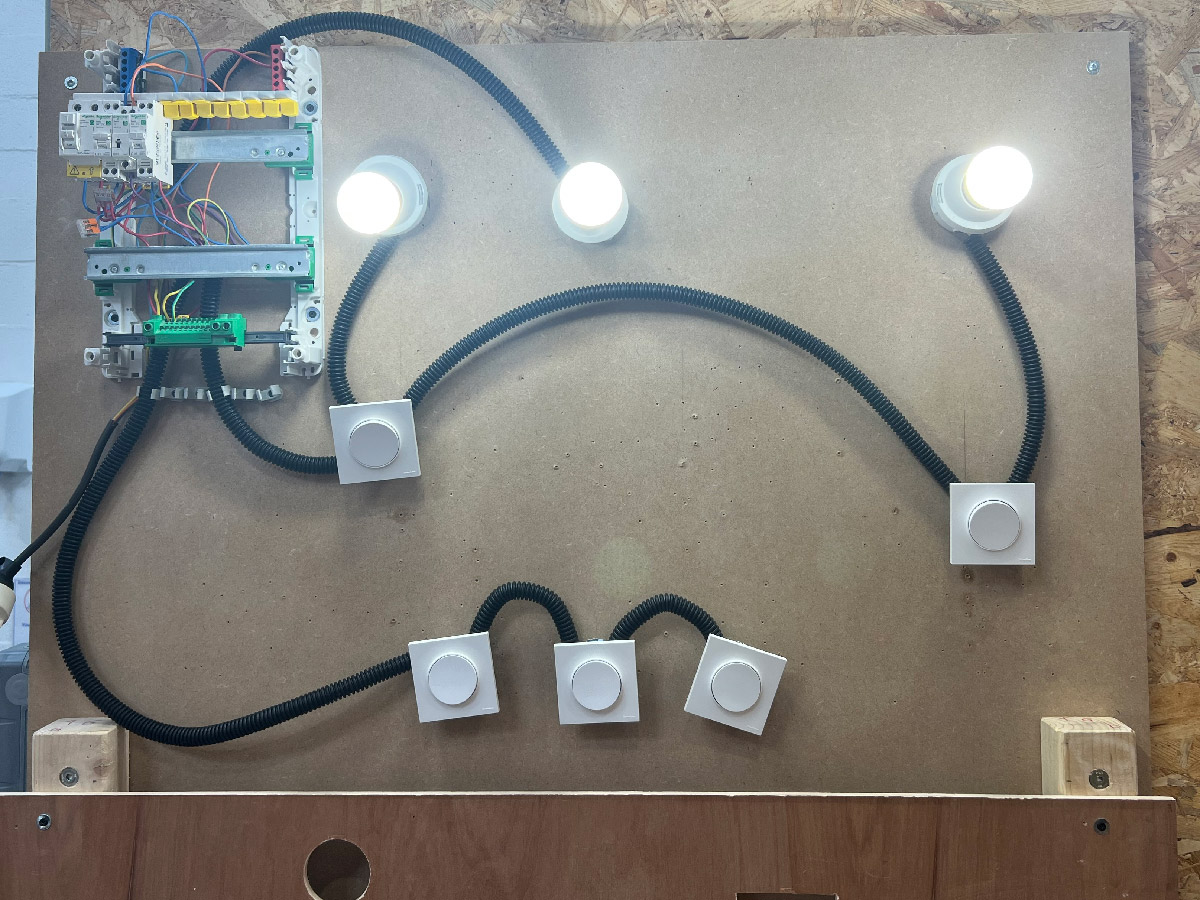
↑ Addition of a third push-button and installation of a toggle switch to control two light points.
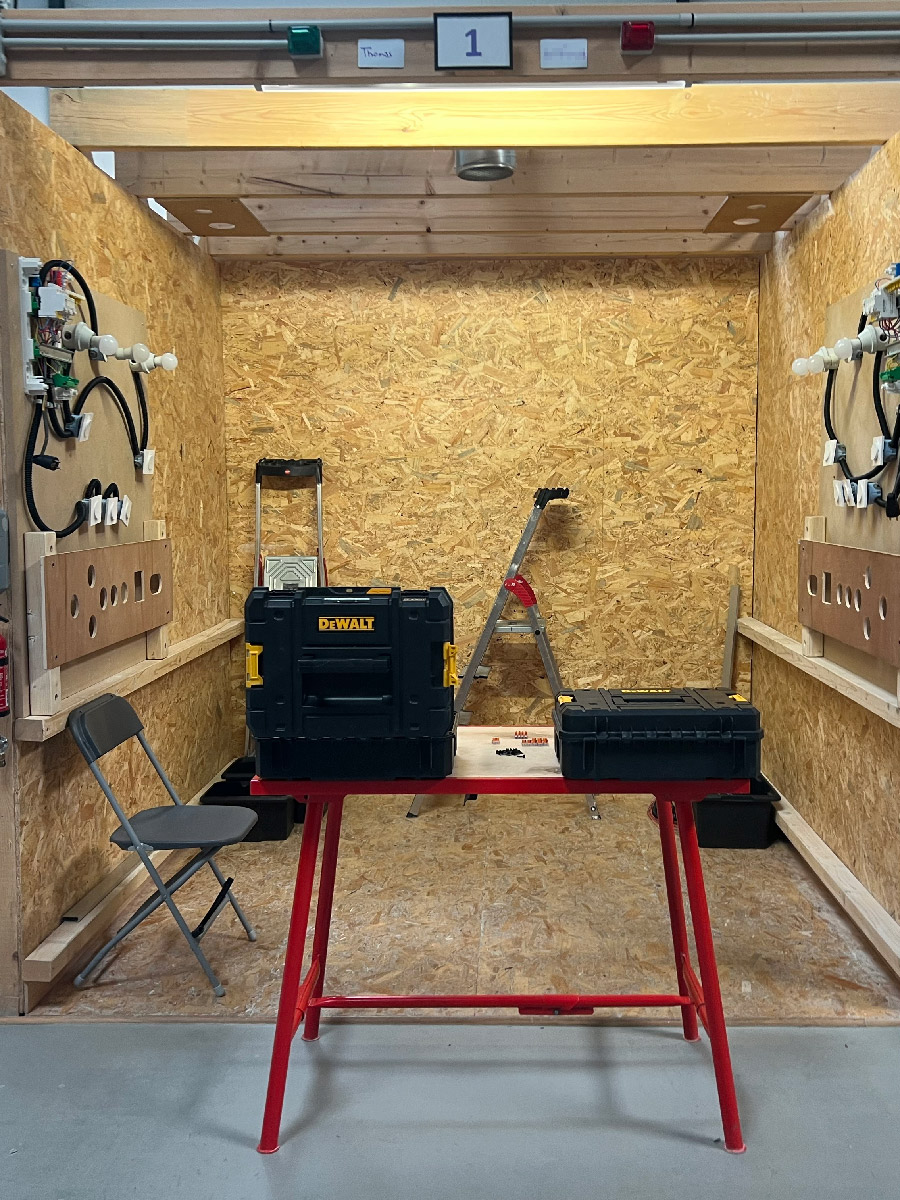
↑ The box where I spent most of my time during that week of training. Each box contains two students, but each of us has their own tools and equipment. We are, of course, allowed to chat and help each other if needed.
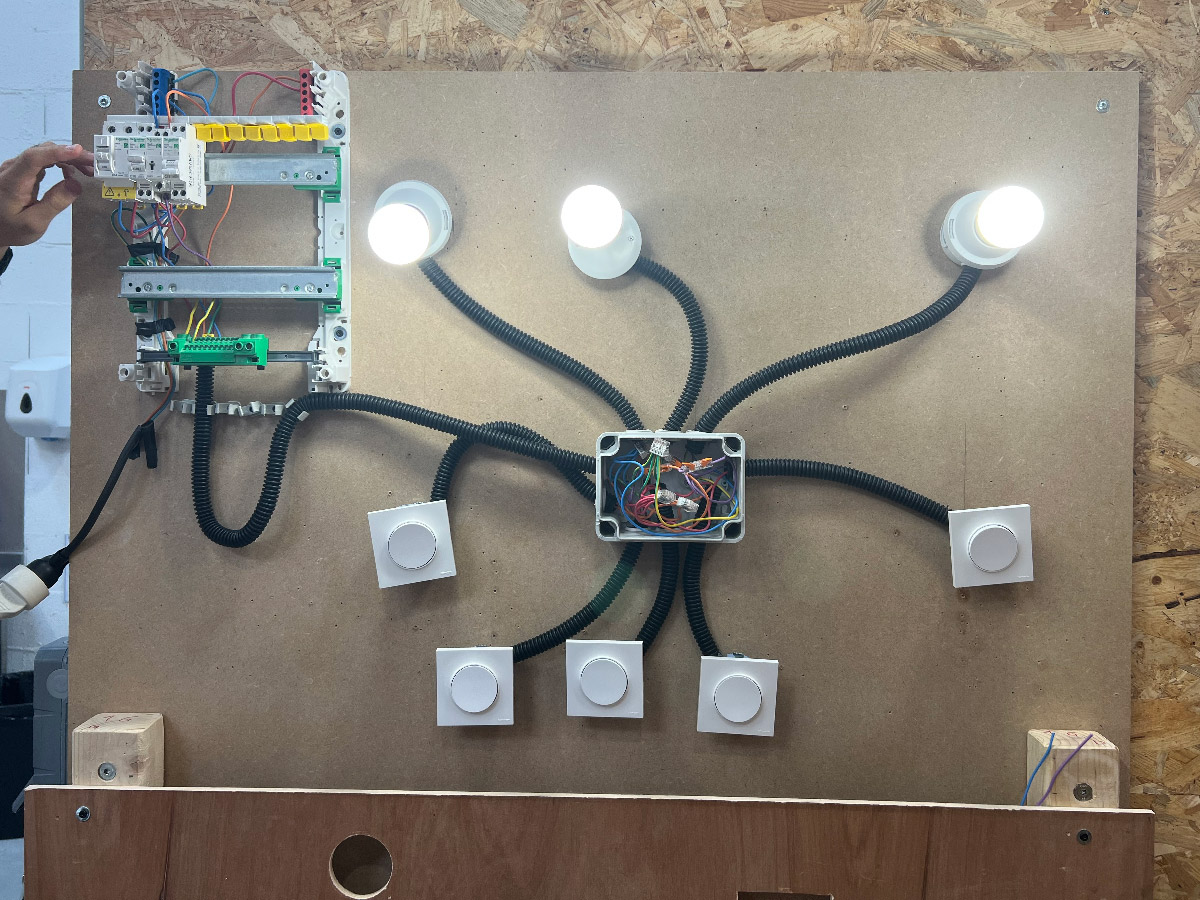
↑ Setting up a (bigger) junction box to centralise the latching and toggle switch circuits, controlled from the same circuit breaker.
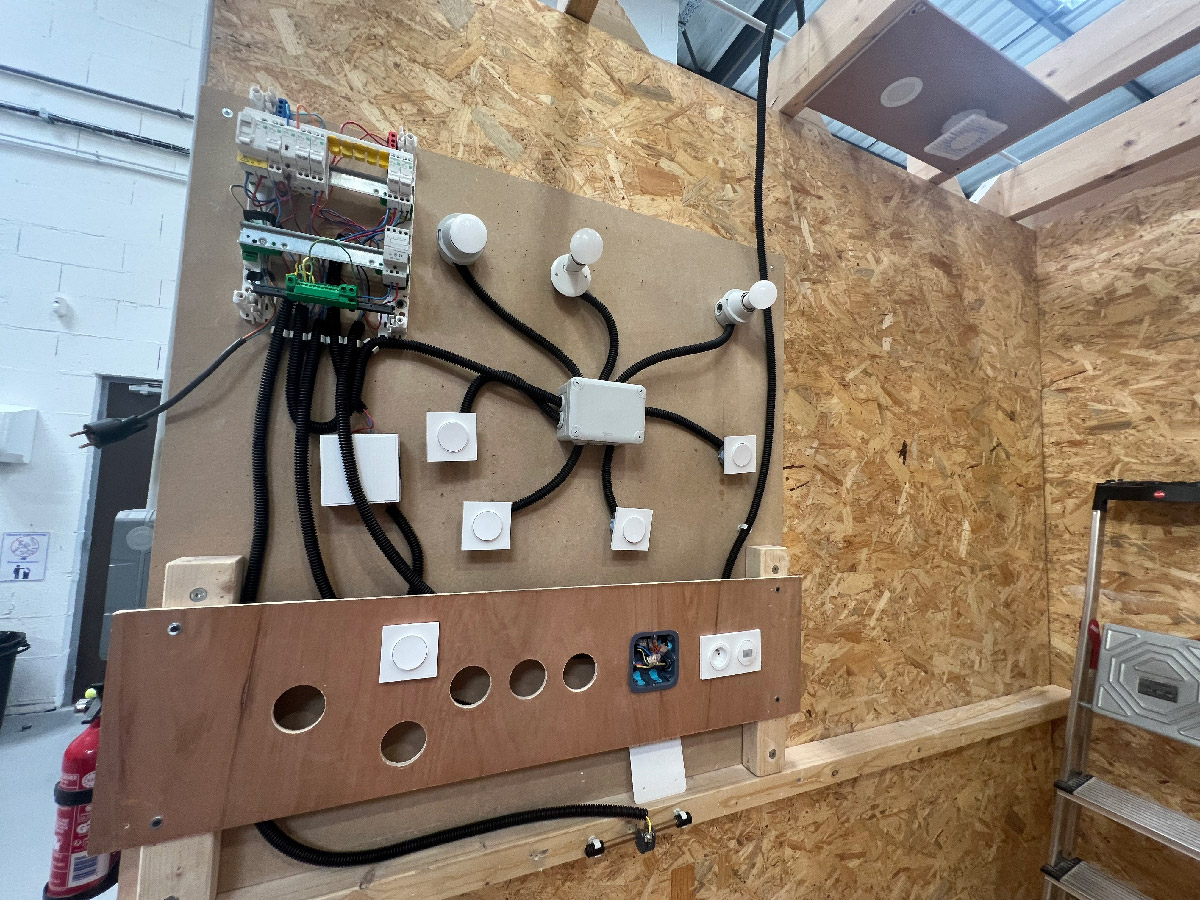
↑ Installation of a doorbell triggered by a push-button, a spotlight and a mechanical ventilation system activated by a motion sensor, and a plug socket.
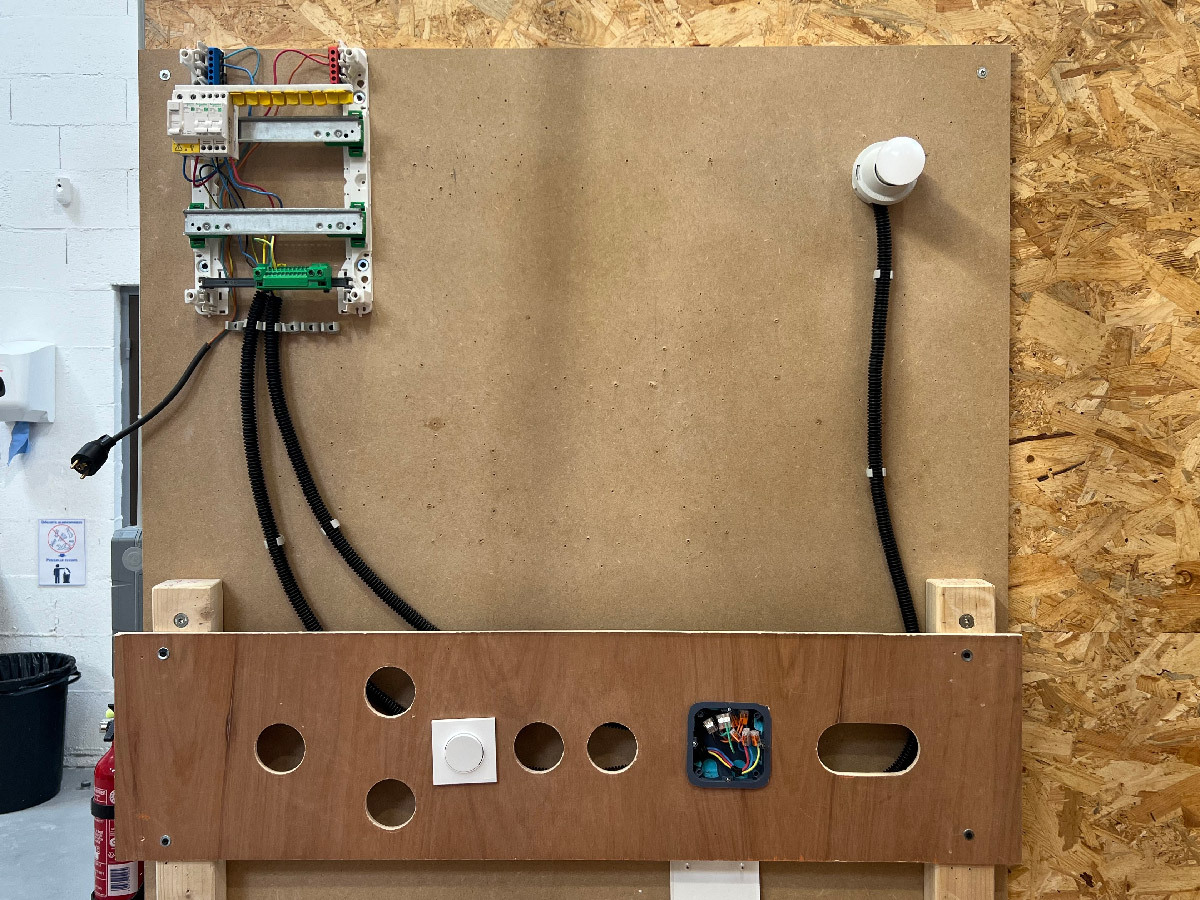
↑ The last day, setting up the base that is used for the next day’s final exam, during which I had to install a plug socket and replace the switch with a motion sensor. That was easy, compared to what I did during the week.
Final thoughts
Initially, I wanted to take that training by pure curiosity, driven by personal matters and the desire to do something unusual in my daily life. I was simply motivated to learn how electricity works, basic skills, and put what I would learn into practice, at home.
That being said, once the training was completed, I was so fascinated by what I learnt and accomplished, and satisfied with how my days were filled, that I didn't want to stop there. I’d like to continue to learn, improve my skills and practice in the field of electricity to, who knows, begin a new work life. I have to think about it, how it could be doable, and so on… it has to mature within myself, of course, but a seed has been planted.
I am very well conscious that during that training, all the work I had to do was condensed in a few square meters, and that the working conditions were easy and almost perfect. No doubt that in real life, both in new builds and in renovation projects, reality is far different, and things are much more complex and hard. I am aware that the electrician job doesn’t consist of just connecting cables, switches, plug sockets… to an electrical board. Far from it. A big part of the work includes drilling, digging, carrying, screwing and so on, struggling in narrow and dirty spaces, difficult to access, etc. It’s an occupation that can be physically demanding. It’s something I tend to appreciate, though, the association between the physical part of the job and the thinking part (e.g., how to optimally install a cable network).
Finally, and it’s very important: even if at the end of that training, I received a certificate and acquired solid basics, I am absolutely not claiming to master anything at all. There are topics I didn’t fully assimilate, I still have a lot of things to learn.
Yet, I think I now have the required skills to know:
- How to work safely
- The good questions to ask myself
- How to refer to and read documentation
- Above all, when to call for a professional electrician for a job I wouldn’t feel up to doing
Safety first.
It was a fascinating week, extremely rewarding. The atmosphere was great, the trainer both good at teaching skills and friendly, and the organisation was perfect. It was a greatly appreciated summer break, far away from my daily life and job. It will, maybe, be the starting point for something new.
And even if I never end up following through with this new idea growing in me, I am very proud to have learnt all of these skills and to be able to put them into practice at home.
I already have a few things to tackle in my home installation, such as:
- Fixing a plug socket that doesn't work (and understanding why it doesn't work).
- Running a new light point from a sub-panel, which will mean working through the rather dirty, and sometimes narrow, unfinished attic.
- Earthing a few plug sockets, if possible (also known as “grounding”, which means connecting an electrical part to the earth for safety reasons).
- The big project: the complete electrical installation of an outbuilding, aka my garage. A small two-storey building where I, of course, park my car, but also do some DIY once in a while, and where I want to be able to plug in some machines and use lights.
Now, all that's left to do is get stuck in!
⚡